
Views: 200 Author: Site Editor Publish Time: 2026-09-21 Origin: Site

A Practical Guide to Syringe Production Line Planning
When planning a syringe manufacturing project, one of the first questions investors and manufacturers usually ask is:
“How many machines do we actually need?”
For example, if the target is 200,000 syringes per day, it may seem easy to calculate. Simply divide the daily target by the working hours and select machines with enough output.
In practice, however, syringe production is much more complicated.
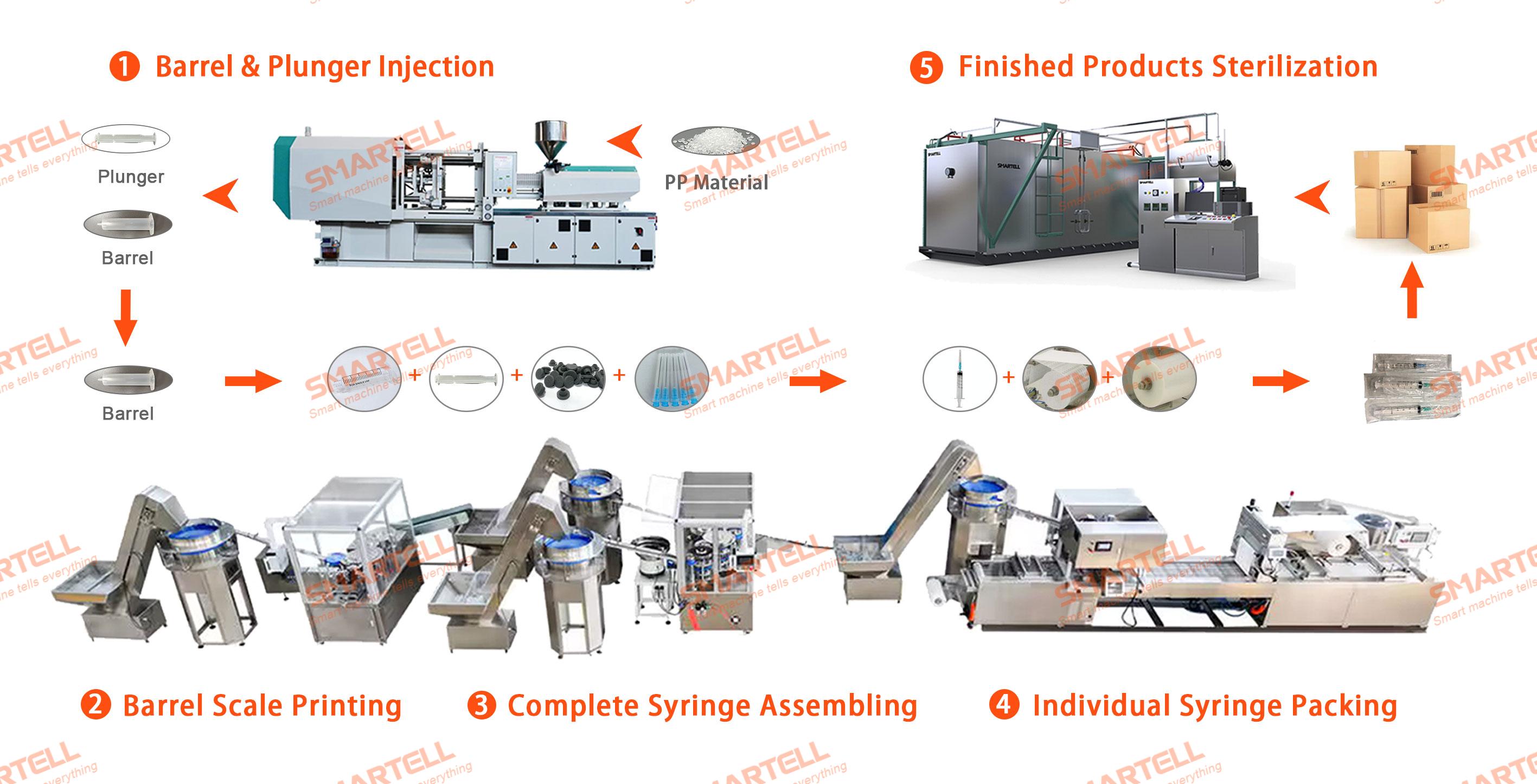
A complete syringe production system may include injection molding, printing, syringe assembly, packaging and sterilization. Each process has its own production speed, equipment configuration and potential bottlenecks.
Therefore, the real question is not simply how many machines are needed.
It is:
How should the entire production system be balanced to reliably achieve the target output?
Let's take 200,000 syringes per day as an example.
If the factory operates one 8-hour shift, the theoretical average output required would be:
200,000 ÷ 8 = 25,000 syringes/hour
But this does not mean that every machine only needs to produce exactly 25,000 pieces per hour.
Production lines need to account for:
Equipment utilization
Mold changes
Material loading
Machine adjustment
Maintenance
Quality inspection
Product changeover
Unplanned downtime
Production efficiency
This means the actual equipment configuration normally needs some capacity margin.
The target should therefore be used as the starting point—not the final calculation.
Before deciding how many machines are needed, the product itself needs to be defined.
Different syringe products require different production configurations.
For example:
1 mL, 2 mL, 3 mL, 5 mL, 10 mL or 20 mL syringes
2-piece or 3-piece syringes
Luer Lock or Luer Slip
Different barrel, plunger and gasket designs
Different printing requirements
Different packaging formats
Different sterilization methods
A 200,000-piece-per-day project for a single syringe specification is very different from a project producing several syringe sizes on the same production system.
This is why production capacity should always be calculated from the product structure first.

Injection molding is usually one of the most important capacity calculations in a syringe project.
The output of an injection molding machine depends mainly on:
Number of mold cavities
Cycle time
Machine utilization
Product design
Material
Mold configuration
A simple theoretical calculation is:
Output = Number of Cavities × 3,600 ÷ Cycle Time
For example, a 16-cavity mold with a 20-second cycle would theoretically produce:
16 × 3,600 ÷ 20 = 2,880 pieces/hour
However, this is only theoretical output.
Actual production will be lower because of mold changes, startup, maintenance, quality control and other production losses.

A manufacturer may think that using a very high-cavity mold is always the easiest way to increase production.
But higher cavity numbers can also mean:
Higher mold investment
More complex mold design
Higher requirements for injection molding machines
More demanding process control
More complicated maintenance
Therefore, the right question is not:
“What is the maximum number of cavities?”
It is:
“What cavity configuration provides the right balance between investment, capacity and production stability?”
The mold cannot be considered separately from the injection molding machine.
The machine needs to match the mold in terms of:
Clamping force
Injection volume
Injection pressure
Plasticizing capacity
Mold dimensions
Production cycle
Automation requirements
For a complete syringe project, different components may also require different molds and machine configurations.
For example, the barrel, plunger and other components may not necessarily be produced using the same machine configuration.
This means that the number of injection molding machines depends not only on the final syringe output, but also on the production requirements of each component.

This is where many production planning calculations become misleading.
Suppose the final target is 200,000 assembled syringes per day.
That does not mean the factory simply needs enough injection molding machines to produce 200,000 barrels.
The same production system must also provide enough:
Barrels
Plungers
Gaskets
Other required components
If one component cannot keep up with the others, the assembly line will eventually become the bottleneck.
Therefore, component production needs to be calculated together.
The goal is not maximum output from one machine. The goal is sufficient output from the complete system.
After molding, syringe barrels may need graduation and other markings.
Printing is another process that needs to be included in capacity planning.
For example, if the injection molding section can supply 30,000 barrels per hour but the printing section can only process 20,000 barrels per hour, the additional injection molding capacity will not increase the final production output.
The printing system should therefore be evaluated based on:
Printing speed
Number of printing stations
Product size
Printing method
Changeover time
Drying or curing requirements
Inspection requirements
The important point is simple:
Upstream capacity should not greatly exceed downstream capacity without a clear reason.
Syringe assembly brings the individual components together to create the finished product.
Depending on the syringe design, the assembly process may include:
Barrel feeding
Gasket feeding
Plunger feeding
Component orientation
Assembly
Inspection
Rejection of defective products
Assembly capacity is therefore another critical factor.
For a target of 200,000 syringes per day, the assembly system must be capable of handling the required production volume with sufficient operating margin.
It is also important to consider how many assembly lines are required.
For example, one high-speed assembly machine may be sufficient for one project, while another project may use multiple assembly machines for:
Different syringe sizes
Different product specifications
Production flexibility
Maintenance redundancy
Future expansion
The “right” number of machines depends on the production strategy.
Once the syringes have been assembled, they still need to be packaged.
Depending on the product and market requirements, packaging may include:
Individual packaging
Blister packaging
Polybag packaging
Tray packaging
Secondary packaging
Cartoning
Packaging capacity needs to match assembly output.
If assembly produces 25,000 syringes per hour but packaging can only process 15,000, finished products will accumulate between the two processes.
This creates additional handling, storage and production management requirements.
A well-designed production line therefore considers packaging before the factory starts operating, rather than adding packaging equipment after the assembly line is already running.

For sterile syringes, the production system does not end after packaging.
Sterilization also needs to be included in the overall production plan.
Depending on the product and process requirements, sterilization may involve methods such as EO sterilization or other applicable sterilization solutions.
When planning sterilization capacity, manufacturers need to consider:
Daily production volume
Batch size
Sterilization cycle
Loading and unloading time
Product packaging configuration
Required sterilization capacity
Supporting facilities
For example, even if the upstream production line can produce 200,000 syringes per day, insufficient sterilization capacity can prevent the factory from achieving the same effective daily output.
This is why sterilization should be considered as part of the complete production system, rather than as a separate process added at the end.
Now we can return to the original question.
How many machines are required to produce 200,000 syringes per day?
There is no universal number.
The answer depends on:
Syringe specification
Number of components
Mold cavity configuration
Injection molding cycle time
Equipment utilization
Printing speed
Assembly speed
Packaging configuration
Sterilization capacity
Daily working hours
Number of shifts
Future expansion requirements
For this reason, two factories with the same target of 200,000 syringes per day may require completely different equipment configurations.
One factory may use fewer high-capacity machines.
Another may choose more machines with lower individual output to achieve greater flexibility and easier maintenance.
Both approaches can be technically reasonable depending on the project.
One of the most common mistakes in production-line planning is focusing too much on the speed of an individual machine.
For example:
Injection molding: 35,000 pcs/h
Printing: 30,000 pcs/h
Assembly: 20,000 pcs/h
Packaging: 18,000 pcs/h
At first glance, the injection molding capacity looks impressive.
But the complete line cannot produce 35,000 finished syringes per hour.
The effective production capacity will be constrained by the processes that cannot keep up.
This is the basic principle of a balanced production line:
The capacity of the complete system is determined by the balance between processes—not by the fastest machine.
The same daily target can require different equipment configurations depending on the factory's working schedule.
For example, a factory producing 200,000 syringes per day on one 8-hour shift has a very different hourly requirement from a factory operating two shifts.
Longer operating hours can reduce the required hourly production rate.
However, longer operating hours also mean that equipment reliability, maintenance planning and shift management become increasingly important.
Therefore, working hours should be decided together with the equipment configuration.
A production line should not only solve today's production target.
It should also consider tomorrow's requirements.
A factory may initially target:
200,000 syringes/day
but later expand to:
Additional syringe sizes
Additional production shifts
Higher annual output
New packaging formats
New product specifications
A good production plan can reserve space and provide a reasonable path for future expansion.
This may include:
Reserved factory space
Modular equipment configuration
Expandable assembly capacity
Additional molding capacity
Flexible packaging systems
Scalable sterilization solutions
Planning for expansion from the beginning can be much easier than rebuilding the entire production system later.
After looking at the complete process, we can see that the answer to the title question is not simply a number.
The more important questions are:
What products will be manufactured?
What is the actual daily target?
How many working hours are available?
What is the capacity of each process?
Where will the bottleneck occur?
How much capacity margin is required?
How will the factory expand in the future?
Only after answering these questions can the equipment quantity be properly determined.
A syringe production project is more than purchasing individual machines.
It is a complete production system that connects:
Injection Molding → Printing → Syringe Assembly → Packaging → Sterilization
Each process must work together.
At SMARTELL, we focus on developing equipment and production solutions around the complete manufacturing process. Depending on the project requirements, the production system can be planned around injection molding, printing, assembly, packaging and sterilization, with the equipment configuration matched to the customer's product specifications and target capacity.
The objective is not simply to provide the fastest machine.
It is to help create a balanced, practical and expandable production system.
So, how many machines do you really need to produce 200,000 syringes a day?
There is no one-size-fits-all answer.
The correct equipment configuration depends on the product, capacity target, working schedule, process requirements and future expansion plan.
A successful syringe production line is not defined by having the fastest individual machine.
It is defined by how well the entire system works together.
From injection molding to printing, assembly, packaging and sterilization, every process needs to be planned as part of one complete production system.
And that is where proper production-line planning makes the difference.