
Views: 0 Author: Site Editor Publish Time: 2026-09-29 Origin: Site

Scaling operations in the medical device sector brings exceptionally high stakes. Dimensional inconsistencies in tubing directly lead to catastrophic product failures and severe compliance breaches. Manufacturers face immense pressure to deliver flawless products every time. Shifting from standard plastic manufacturing to medical-grade precision demands highly specialized equipment. You cannot rely on generic machinery when patient safety is on the line. Successful procurement requires balancing high-speed output against strict cleanroom requirements during IV set tube production.
This guide provides a comprehensive technical and operational evaluation framework. We will help buyers assess new extrusion and cutting equipment effectively. You will learn how to validate machine claims, understand core components, and mitigate rollout risks. You will also discover practical strategies to seamlessly integrate these complex systems into your existing cleanroom facility. By following these insights, you ensure your production lines meet the highest industry standards.
Achieving consistent 2.0mm (and similar) OD/ID dimensions requires specialized screw geometries optimized specifically for soft PVC and PU.
The cutting mechanism must synchronize with extrusion line speeds to prevent tube deformation or ovality.
Factory Acceptance Testing (FAT) parameters are the most critical milestone when shortlisting equipment vendors.
Precision medical manufacturing requires strict adherence to environmental controls. Dust-proof machine architectures form the foundation of cleanroom compliance. Unsealed hoppers, exposed transmission belts, or open cooling tanks introduce airborne particulates. These contaminants compromise ISO Class 7 or ISO Class 8 environments. Medical extruders must utilize fully enclosed gearboxes, sealed servo motors, and centralized exhaust routing. These design choices prevent the machinery itself from acting as a contamination source.
Buyers must navigate the delicate trade-off between operational speed and dimensional precision. Marketing materials often highlight theoretical maximum line speeds. However, running a system at peak speed frequently degrades wall thickness consistency. Continuous production demands reliable stability over long shifts. Acceptable tolerance deviations typically sit around +/- 0.05mm. Pushing equipment beyond its optimal operational envelope increases scrap rates drastically. You should evaluate equipment based on its sustainable continuous speed rather than its theoretical limit.
Material specificity dictates machine configuration. Soft, medical-grade PVC and polyurethane (PU) exhibit unique rheological behaviors. These polymers are highly shear-sensitive and prone to thermal degradation. Standard equipment cannot process these materials effectively. Using a generic tube extruding machine often fails to prevent material degradation because standard screw profiles generate excessive friction. This friction causes localized overheating, leading to polymer yellowing and compromised biocompatibility. You need equipment built specifically to manage the delicate melt temperatures of medical resins.
Implement automated, enclosed vacuum loaders to transport raw resins.
Utilize dehumidifying dryers for PU to prevent moisture-induced bubbling.
Maintain strict lot traceability from the hopper through the die head.
When evaluating a high-precision PVC tube extruder, you must examine the screw and barrel design carefully. Soft PVC requires specific Length-to-Diameter (L/D) ratios, typically ranging from 24:1 to 28:1. This geometry ensures a gentle melting process. Proper screw design utilizes a gradual compression zone. This prevents shear-induced burning while maintaining absolute melt uniformity. If the screw generates too much shear, the PVC will degrade before it reaches the die.
The melt pump and tooling play vital roles in stabilizing output. Melt pumps eliminate pressure pulsation originating from the extruder screw. They ensure a constant volumetric flow into the die head. Micro-adjustments in the die head directly impact continuous wall thickness. High-quality tooling allows operators to center the pin and die with micrometer precision. This eliminates concentricity errors. Without a melt pump, slight variations in resin feed translate into wavy tubing profiles.
Vacuum sizing and cooling tanks determine the final dimensional stability of the product. Closed-loop water cooling systems provide rapid, uniform temperature drops. Rapid cooling prevents the soft tubing from collapsing under its own weight. All wetted components must consist of medical-grade stainless steel (SUS304 or SUS316). This requirement prevents rust and bacterial buildup in the cooling water. Vacuum calibration introduces negative pressure inside the sizing sleeve. It forces the external wall of the tube against the calibration tool, ensuring rapid stabilization.
| Component | Standard Extrusion Line | Medical-Grade Extrusion Line |
|---|---|---|
| Screw Design | Generic profile, high shear | Low-shear, L/D 24:1 to 28:1, optimized for PVC/PU |
| Pressure Control | Relies on screw RPM only | Integrated melt gear pump for zero pulsation |
| Cooling Tank | Standard steel or open bath | Closed-loop SUS304/316, multi-stage vacuum calibration |
| Motor Type | Standard AC induction | Sealed servo motors (dust-proof) |
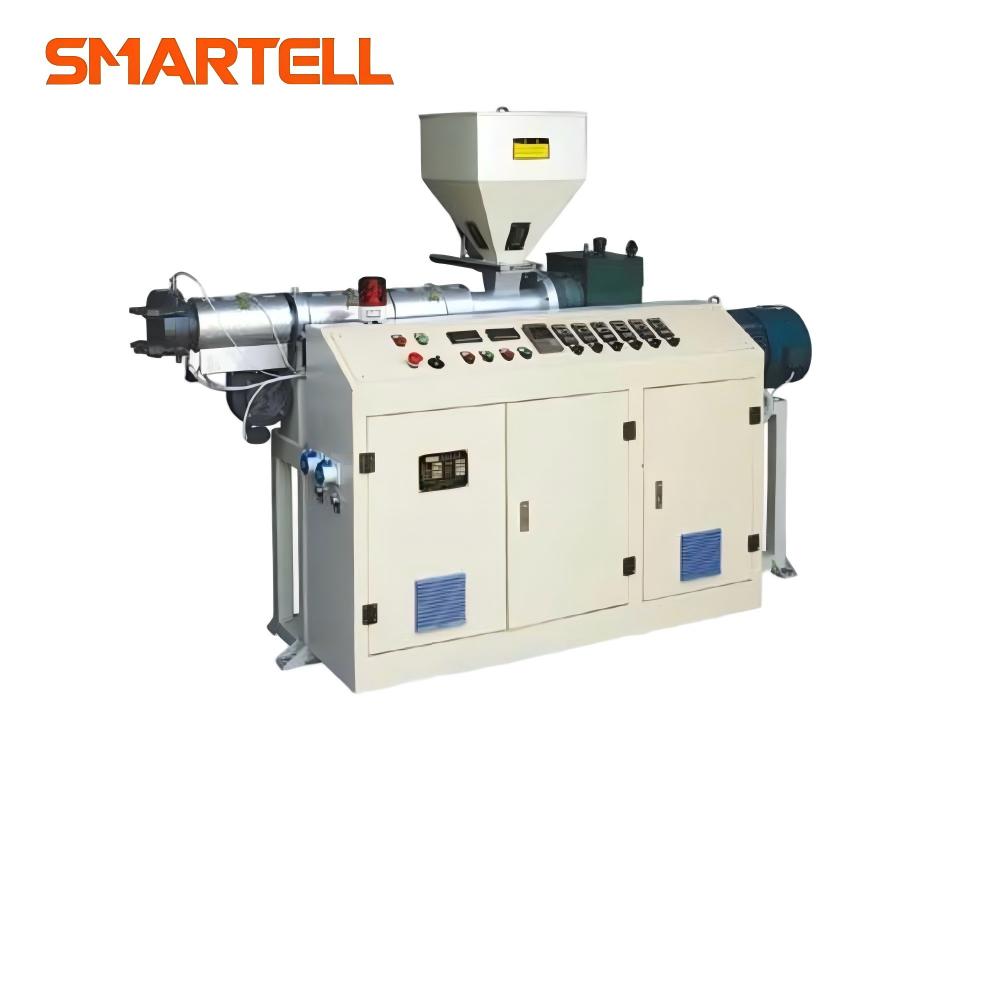
The final physical process involves cutting the continuous profile into precise lengths. Servo-driven rotary cutters and fly-knife technologies represent the two primary mechanisms. Servo-rotary systems spin a blade continuously, synchronizing the blade passage with the tube speed. Fly-knife systems actuate a blade on demand. Handling flexible, soft-walled tubing requires exceptional blade sharpness and speed. If the blade moves too slowly, it crushes the profile. Modern infusion tube cutting relies heavily on high-speed fly-knife mechanisms to slice through the material cleanly without causing ovality.
Traction units dictate the success of the cutting phase. A caterpillar haul-off unit pulls the tubing through the cooling tanks. This haul-off unit must synchronize perfectly with the cutting mechanism. Dual-servo synchronization ties the speed of the traction belts directly to the firing rate of the cutter. If the traction belt pulls faster than the cutter can process, it stretches the tube. This stretching leads to micro-tearing and dimension loss before the cut occurs. Precise electronic gearing between these two servos is absolutely non-negotiable.
Length accuracy defines the yield rate of your production run. Standard acceptable cut-length tolerances for infusion sets usually hover around +/- 2.0mm over a 1500mm length. Achieving this accuracy requires high-resolution optical sensors and digital encoders. Encoders track the exact linear footage passing through the haul-off unit. They feed this data back to the PLC in milliseconds. Modern modules adjust the cutting trigger dynamically to account for microscopic slippage in the traction belts.
Procuring advanced equipment solves only half the operational puzzle. Facility integration presents significant physical challenges. Medical extrusion lines demand a substantial linear footprint. A typical line requires 15 to 20 meters of straight, uninterrupted space. This accommodates the extruder, extended cooling tanks, dual haul-offs, and automated coiling stations. Attempting to bend the line or shorten the cooling tanks compromises thermal stabilization. You must map your cleanroom floor plan meticulously before signing a purchase order.
Utility setups dictate daily operational stability. Medical equipment requires extremely consistent support systems. Chilled water must remain at a steady temperature, usually between 10°C and 15°C, to ensure repeatable shrinkage rates. Compressed air must meet strict purity standards. Oil or moisture in the air lines will contaminate the cutting pneumatics and the cleanroom atmosphere. Electrical routing requires dedicated, isolated circuits to prevent voltage spikes from resetting sensitive PLC controllers.
Chiller Capacity: Verify adequate tonnage to handle constant heat extraction from the vacuum tanks.
Air Filtration: Install coalescing filters to achieve ISO 8573-1 Class 1.2.1 air purity.
Power Conditioning: Implement active voltage regulators for all servo drives and heating zones.
Drainage Routing: Ensure sanitary closed-loop drainage that prevents stagnant water inside the cleanroom.
Operator adoption frequently introduces unexpected delays. Transitioning to highly automated systems involves a steep learning curve. Operators must master PLC touch-screen controls, digital recipe management, and continuous feedback loops. Routine calibration tasks shift from mechanical adjustments to digital parameter tuning. You must secure comprehensive onsite training from your vendor. Ensure operators understand how to interpret pressure transducer data and melt temperature readouts.
Evaluating vendors in medical tube extrusion requires rigorous validation of their marketing claims. Many suppliers promise "high-speed" and "high-precision" simultaneously. You must request empirical data to verify these statements. Ask vendors for capability studies, specifically Cpk (Process Capability Index) validation. A Cpk score above 1.33 demonstrates the machine can maintain tolerances reliably over time. Do not accept short video demonstrations as proof of continuous operational stability.
Factory Acceptance Testing (FAT) represents your final defense before the equipment ships. You must establish non-negotiable test parameters early in the negotiation process. Supply the vendor with your exact resin grade. Generic substitute resins will not reveal the true thermal behavior of your specific PVC blend. Demand an extended continuous run, typically 4 to 8 hours. This proves thermal stability, cooling efficiency, and cutting synchronization under realistic conditions. Monitor scrap rates during this entire test.
After-sales support determines the lifespan of your investment. Proprietary electronics trap you into expensive, delayed service contracts. Demand off-the-shelf, globally recognized components like Siemens or Allen-Bradley PLCs. These allow your local maintenance teams to source replacements quickly. Investigate the vendor's localized technical support network. If a servo drive fails, waiting two weeks for overseas shipping will paralyze your cleanroom operations.
Failing to provide exact resin lot samples for the FAT run.
Accepting FAT results based on a 30-minute test run instead of an entire shift.
Ignoring the language capabilities and localization of the PLC interface.
Selecting the right PVC tube extruding and cutting machine requires prioritizing dimensional stability and cleanroom integrability over theoretical maximum speeds. Your primary focus must remain on precision. Reliable screw geometries, melt pump integration, and precise servo synchronization define successful production runs. Sacrificing these elements for cheaper equipment leads directly to unmanageable scrap rates and compliance failures.
Advise your procurement teams to lock down exact material specifications immediately. Determine your specific PVC or PU blends and set exact dimensional tolerances. Armed with this data, you can request highly customized technical proposals. Hold your shortlisted vendors accountable through rigorous empirical data validation and demanding FAT protocols. Taking these deliberate steps ensures your manufacturing lines deliver flawless medical products efficiently.
A: The ideal L/D (Length-to-Diameter) ratio for processing heat-sensitive soft PVC ranges between 24:1 and 28:1. This specific geometry provides a gentle, gradual compression zone. It prevents excessive shear friction, which causes localized overheating and polymer degradation. This ensures a uniform, stable melt before the material enters the die head.
A: It maintains compliance through strict architectural enclosures. High-end machines feature fully sealed servo motors and enclosed gearboxes to prevent oil or dust emissions. They utilize medical-grade stainless steel (SUS304/316) for all contact parts, avoiding rust. Additionally, enclosed vacuum hoppers prevent airborne resin particulates from entering the ISO Class 7/8 environment.
A: Yes, but it requires operational adjustments. Processing both materials on one line demands distinct temperature profiles and potential screw changes, depending on the PU grade. Operators must purge the system meticulously to prevent cross-contamination. PU requires extensive pre-drying, whereas PVC does not, requiring separate material handling protocols.
A: Ovality occurs when the cutting blade moves too slowly or the tube remains too warm and soft at the cutting stage. It is prevented by utilizing ultra-fast, sharp fly-knife systems and ensuring the tube is fully cooled via extended vacuum water tanks. Precise dual-servo synchronization also prevents pre-cut stretching.