

Qualification covers three separate evidence streams — materials, equipment, and finished product including sterilization — each with test conditions, sample quantities, measurement items and acceptance criteria written before purchase orders are placed. Design, installation, operational and performance qualification form four documented gates, sterilization validation runs alongside the line, and every later change starts a documented assessment.

What production line qualification should cover
A line qualification covers three layers, documented separately: the materials and components that become the product, the machines and processes that convert them, and the finished device including sterilization for sterile products — one layer's result cannot cover a gap in another.
| Layer | What it covers | Owner | Output | Acceptance basis |
|---|---|---|---|---|
| Material and component | Incoming resin, additives, inks, adhesives and primary packaging, with supplier certificates and your own identity tests | Quality with purchasing | Material specification and incoming inspection record | Limits and sampling plan agreed before the first receipt |
| Equipment and process | Each machine and the integrated line: mechanics, controls, utilities, moulds, assembly, packing | Validation with production and maintenance | Design, installation, operational and performance protocols and reports | Criteria signed before each test runs |
| Finished product and sterilization | Product performance, bioburden, sterilization and residuals; for devices labelled sterile, FDA reviews the sterilization method and the validation activities used to show the device can be effectively sterilized | Sterilization owner with regulatory affairs | Process validation report and release records | The product's method standard plus each market's requirements |
The three layers can be worked in parallel, but they should not be signed off in parallel: a material change touching a product-contact surface, a machine parameter affecting a critical dimension, or a new sterilization load each undermines conclusions drawn downstream of it.
A supplier that offers the whole sequence can shorten the interface work, but one commercial scope does not merge the evidence: you still hold one protocol per layer and own the acceptance criteria.
How DQ, IQ, OQ and PQ divide the work
Design, installation, operational and performance qualification are four gates applied twice — to each machine and then to the integrated line — and they only hold inside a documented, risk-based quality system: the US Quality Management System Regulation, effective 2 February 2026, incorporates ISO 13485:2016 and requires risk management, so the written protocol, not memory, is the evidence.
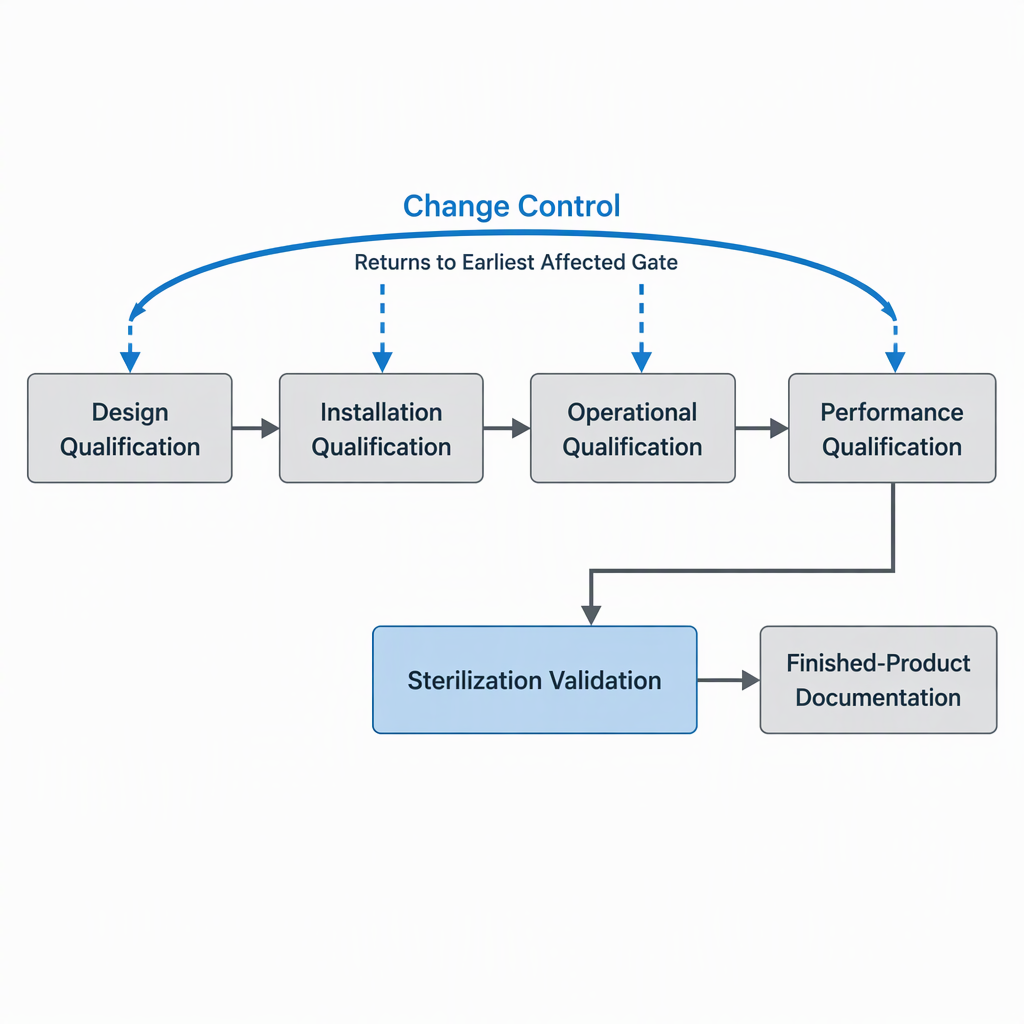
- Design qualification. Freeze the user requirement specification — output rate, product sizes, tolerances, product-contact materials, cleaning and recorded data — and check the proposed design against it before manufacture, while a wrong interface is still cheap to correct.
- Installation qualification. Confirm that what arrived matches the agreed specification: identifiers, materials of construction, utilities, calibration, guarding, software versions. Before anyone reaches inside an enclosure, switch the equipment off and disconnect it from the electrical supply and from compressed air, then work only through the access points the manufacturer's manual permits, and record any accepted deviation.
- Operational qualification. Challenge the machine across its intended operating range, including the worst-case conditions you identified, and record each parameter against its pre-written criterion. Include alarm and interlock checks so a failure stops the process instead of passing silently.
- Performance qualification. Run the line under normal production conditions with your own materials, moulds, utilities and operators, and measure product against specification over enough production to show the process is stable.
- Close at line level. Repeat the relevant checks on the integrated line, because a machine that passes alone can still fail when it feeds the next unit; then approve the reports and hand the accepted configuration to change control.
What a defensible qualification protocol must state
Every protocol should let a reviewer who was not in the room repeat the test: the equipment and product variant covered, the test conditions, the sample quantity and its basis, the measurement items and instruments, the acceptance criteria, the recording format, and the rule for handling a result outside the criteria. Criteria belong in the protocol before the first measurement, because a criterion agreed after the data is in hand proves nothing.
- Scope: equipment identification, line configuration, product family and sizes covered, protocol version.
- Test conditions: ambient and utility conditions, operating parameters, worst-case condition under test and why it is worst case.
- Sample quantity, how the number was derived from the risk assessment and the method standard, and what it must detect.
- Measurement items: parameter, instrument, calibration status, unit, resolution and who records each value.
- Acceptance criteria as a value or attribute decision with its tolerance, signed before execution.
- Deviation rule: who stops the test, who investigates, what re-test is allowed, how the deviation is closed.
- Records: raw data location, retention period, reviewer and approver roles.
What a reviewer expects to see for a sterile device is set out in FDA's guidance Submission and Review of Sterility Information in Premarket Notification (510(k)) Submissions for Devices Labeled as Sterile, issued in January 2024: it describes the sterilization-process information FDA recommends, covers pyrogenicity information, and points to the FDA Recognized Consensus Standards database for the current edition of each standard it references.
How to qualify materials separately from machines
Material qualification is its own documentation stream: for each resin, additive, ink, adhesive or primary-packaging component, keep a specification, the supplier's certificate of analysis, your own identity and acceptance tests, the sampling plan and the disposition decision. Keeping it out of the machine reports stops a substitution being absorbed silently into an equipment record, and material control belongs in the same documented, risk-based quality system as the rest of the line.
- A written material specification per grade, covering the properties that matter to the product and to the process.
- Incoming inspection per receipt, with the sampling plan stated in the record.
- The supplier's certificate of analysis filed against the lot actually received, not the grade in general.
- Identity checks that would catch a mislabelled or substituted lot, and traceability from each incoming lot to the product lots made from it.
- Storage and handling conditions, including shelf life and moisture or contamination controls.
- A change-notification route for formulation, additive or plant changes.
A certificate records what the supplier tested; a specification records what you require. Neither shows that the material behaves as intended through your moulding, assembly, printing or sterilization steps, so test the properties your process depends on and re-test when the grade or the supplier changes.
Where sterilization validation fits in the sequence
Sterilization validation belongs to the finished-product layer, but it is planned alongside equipment qualification, because a cycle is validated against a defined product and load configuration the qualified line must produce repeatably. FDA states that devices are sterilized by several methods — moist heat, dry heat, radiation, ethylene oxide (EtO) gas and vaporized hydrogen peroxide — that it reviews the sterilization method and validation activities for sterile-labelled devices in premarket submissions, and that it inspects facilities to confirm validated sterilization processes. The working order is: qualify the line, freeze the load configuration, validate the cycle against it, then release product against that validated state.
The consensus standards FDA names for ethylene oxide work are ANSI AAMI ISO 11135:2014, covering how an EO process is developed, validated and controlled, and ANSI AAMI ISO 10993-7:2008(R)2012, covering acceptable residual levels; for low-temperature vaporized hydrogen peroxide it notes recognition of ISO 22441:2022.
Which edition is acceptable is a recognised-edition question, and FDA keeps the answer in its Recognized Consensus Standards database, updated when FDA recognizes a standard. Confirm the edition there, check the publisher's status of that edition, and check which edition your other markets adopt, because US recognition does not establish what another regulator requires.
Residual levels are where a sterilization claim is easiest to get wrong. The acceptable level depends on the device category and exposure route defined in the applicable residuals standard, so take the limit from the current edition of that standard for your device rather than from a supplier's summary, and confirm with each market's regulator which standard and edition it expects.
How change control keeps an existing qualification valid
Any change to the qualified state — a replaced or overhauled machine, new tooling, a modified parameter, a different sterilization load or site — starts a documented assessment before the line runs again, and that assessment decides whether re-qualification, re-validation or a regulatory submission is needed. For a device with a US 510(k) clearance, FDA's guidance Deciding When to Submit a 510(k) for a Change to an Existing Device describes when a change to manufacturing processes or sterilization arrangements may trigger a new premarket notification.
Record the outcome either way: an assessment that concludes no re-qualification is needed is itself evidence of control in a documented, risk-based quality system.
| Change | Example | First question | Records to update |
|---|---|---|---|
| Like-for-like replacement | Same model and specification | Identical in form, fit and function, including controls and instrumentation? | Installation record, calibration, drawing and spares references |
| Process parameter | New cycle time, temperature or pressure set point | Does the new setting stay inside the validated range? | Operational and performance data, release criteria |
| Sterilization arrangement | New chamber, load pattern, site or cycle | Does the validated load configuration still hold? | Sterilization validation report and a submission assessment |
| Control software | Firmware or PLC upgrade, new data logging | Does it touch a controlled or recorded function? | Software version list, installation and operational records |
| Material or supplier | Different resin lot or new component supplier | Does the material still meet the qualified specification? | Material qualification record and traceability |
What to request from the equipment supplier
Ask for the documents that will sit inside your own protocols, and agree them in the contract, not at handover; the checklist below lists what to request. Where one supplier delivers the whole sequence — customised moulds, injection moulding, printing, assembly, packing and ethylene oxide sterilization equipment — request the interface documents between those units explicitly, because interface assumptions are where integrated packages fail.
- Agreed equipment specification and drawings, referenced in the purchase contract.
- Material and product-contact declarations, with certificates for the units actually delivered.
- Calibration certificates and traceability for every installed instrument.
- Factory acceptance protocol and raw results, not a summary sheet.
- Software and firmware version list, plus the change-notification commitment.
- Installation, operation and maintenance manuals that identify permitted access points and the isolation steps required before access.
- Utility requirements — power, compressed air, water, steam, drainage — each with its tolerance.
- Spare-parts list, wear-part recommendations, and a training plan with records for the people who will run the line.
Conclusion
Structure the programme so each layer produces its own signed evidence, and treat the written protocol, not the delivery date, as the deliverable. Close material, equipment and sterilization qualification in order, keep every acceptance criterion ahead of the test that measures it, and route each later change through the same assessment — the value of a qualification is that it still describes the line you are actually running.
- Three streams: materials, equipment and process, and finished product including sterilization, each with its own protocol, owner and records.
- Four gates: design, installation, operational and performance qualification, applied per machine and again to the integrated line, inside a documented, risk-based quality system.
- Written criteria first: test conditions, sample quantity and its basis, measurement items and acceptance criteria, all before the first run.
- Changes assessed: a documented assessment decides whether a change needs re-qualification, re-validation or a new premarket notification.
Frequently asked questions
Most difficulties trace back to a protocol written after the test or an acceptance criterion agreed after the data arrived.
Which standards should we cite, and how do we check that the edition is still current?
Cite the method standard governing the specific test and the process standard governing the process you are validating, and record the edition year in the protocol. For the United States, confirm the current edition in the FDA Recognized Consensus Standards database.
FDA's January 2024 sterility-information guidance points sponsors to that database for the current edition of each standard it references. Recognition in one market does not establish what another requires, so check each market's adopted edition separately.
Can a supplier's certificates replace our own site validation?
No. A certificate describes the supplier's system or that component, not your installed line. Keep supplier documentation as incoming input and your own qualification records as the record that the line works, plus incoming verification that each delivered unit matches the one you ordered.
A supplier's published scope tells you what that supplier builds; it starts your specification and your interface questions rather than replacing tests on what you receive.
How many samples and what acceptance criteria should the protocol use?
The quantity comes from your risk assessment and the governing method standard, and the acceptance criteria must be signed before the first sample is measured. FDA's sterility-information guidance sets out the validation information a reviewer expects but supplies no sample number or acceptance value for your product; those come from the method standard and your specification, and you can confirm the recognized edition in the FDA Recognized Consensus Standards database.
When does an already qualified line need revalidation?
Change triggers it rather than the calendar alone: a replaced or overhauled machine, new tooling, a changed parameter, a new material or supplier, a different sterilization load or site, or a control-system upgrade each puts the qualified state in question. For a device with a US 510(k), the assessment also decides whether a new premarket notification is required.
Record the conclusion either way: in a documented, risk-based quality system, an assessment that finds no re-qualification necessary is itself evidence that the change was controlled.
Does a supplier's factory acceptance test count as our performance qualification?
No. A factory acceptance test shows the equipment met the supplier's protocol at the supplier's site; operational and performance qualification are your evidence that it meets your criteria at your site, with your materials, utilities and operators. Take the acceptance protocol and its raw results as input to installation qualification, then repeat the checks that matter for your product in your own environment.
Can one qualification protocol cover several identical machines?
The template, test conditions and criteria can be shared, but the records must be unique to each unit: equipment identifier, installed configuration, instrument calibration status, raw data and approval. Otherwise one machine cannot be withdrawn, repaired or replaced without unpicking a document that covers several.