

Plan a syringe production line as one controlled system: confirm whether the finished device is an empty sterile single-use hypodermic syringe for manual use, then map molds, injection molding, printing, assembly, blister packaging and sterilization handoff as connected interfaces, and define sterile-barrier packaging requirements before asking suppliers for quotations.
Define the syringe scope before selecting equipment
Start by confirming the syringe family, because the FDA recognition record for ISO 7886-1:2017 describes empty sterile single-use hypodermic syringes for manual use, with or without needle, and excludes insulin syringes, glass syringes, power-driven pump syringes, prefilled syringes and syringes stored after filling.
If the project involves a prefilled, pump-use, insulin or glass syringe, do not reuse a manual-syringe line plan as the basis for equipment selection. Define that product category separately before you discuss molds, assembly fixtures, packaging formats or validation evidence.
For RFQ purposes, the finished-product definition should state syringe type, intended filling pathway, needle configuration, packaging format, market destination and any exclusions. This prevents suppliers from quoting a mechanically plausible line that does not match the regulated finished device.
Map the line from molding through packaging
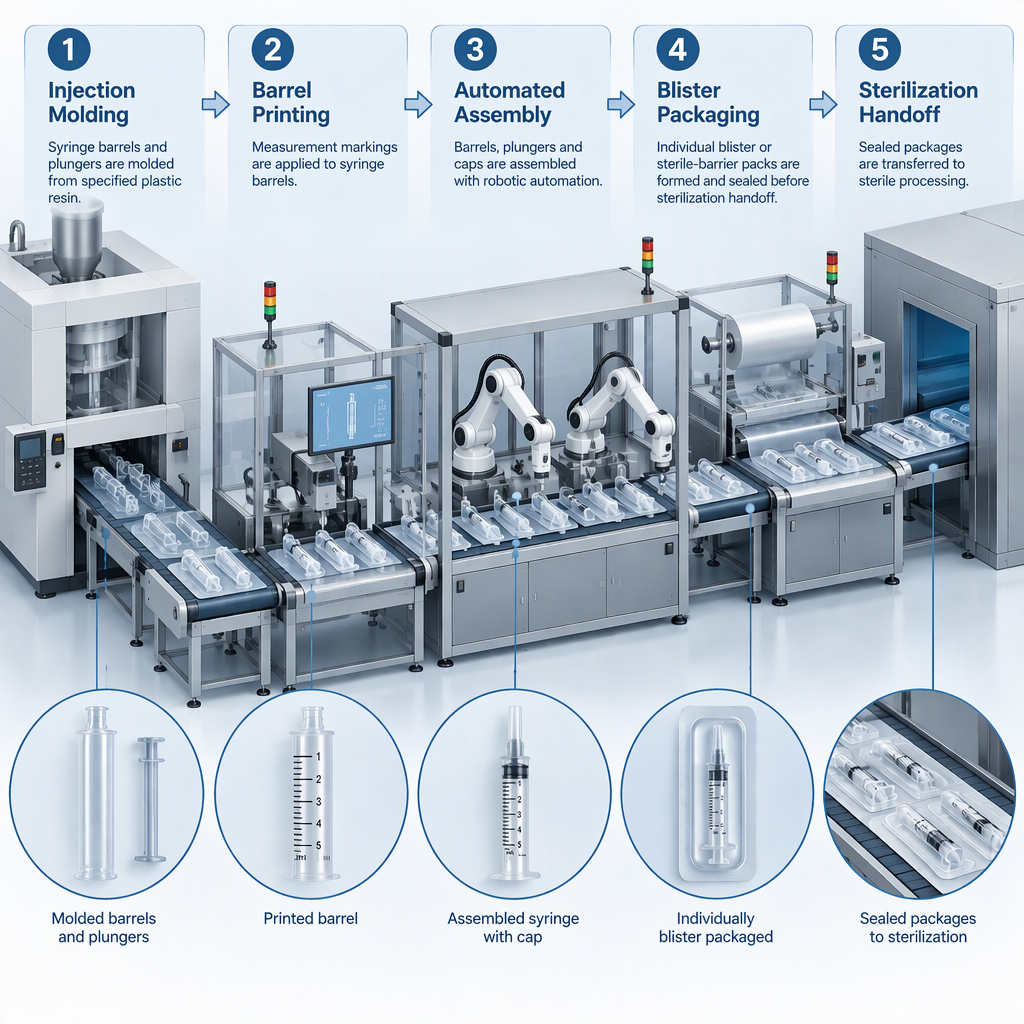
Plan the line by interface, not by isolated machine name: SMARTELL TECHNOLOGY CO., LTD. describes a full automatic plastic syringe manufacturing plant scope that includes molds, injection molding machines, barrel pad printing, automated assembly, blister packaging, ETO sterilization, workshop zoning, installation and technical support.
- Molding definition: define syringe sizes, mold responsibilities, resin handling assumptions and molded-part transfer points before selecting downstream automation.
- Printing interface: specify barrel pad-printing requirements, artwork approval flow and inspection expectations so printing is not treated as an afterthought.
- Assembly interface: align barrel, plunger, gasket, needle or cap handling, because automated assembly has to match the finished syringe configuration.
- Packaging interface: define blister packaging format and transfer conditions before deciding how the assembled syringe exits the clean process flow.
- Sterilization handoff: plan the ETO sterilization interface as a project boundary that must be connected to packaging, labeling and release documentation.
| Planning interface | Buyer decision before RFQ | Why it matters |
|---|---|---|
| Molds and injection molding | Who supplies molds, molding machines and change parts? | Tooling ownership affects layout, spare parts and qualification planning. |
| Pad printing | What print content, position and inspection method will be required? | Print requirements influence feeding, registration and rejection flow. |
| Automated assembly | Which components must be assembled automatically? | Component scope determines fixtures, feeding systems and line balancing. |
| Blister packaging and sterilization handoff | What pack format and sterilization interface will the line support? | Packaging and terminal-sterilization planning must be coordinated early. |
Translate finished-product standards into equipment inputs
Use standards as requirement translators: the FDA record for ISO 7886-1:2017 defines the manual sterile syringe scope and exclusions, while the FDA record for ISO 11607-1:2019 covers materials, sterile-barrier systems and packaging systems intended to maintain sterility of terminally sterilized medical devices until point of use.
| Reference area | What it helps define | How to use it in line planning |
|---|---|---|
| Manual sterile hypodermic syringe scope | Empty sterile single-use manual syringes, with or without needle, for aspiration and injection after end-user filling. | Confirm the product category before selecting molds, assembly tooling and inspection points. |
| Scope exclusions | Insulin, glass, power-driven pump, prefilled and post-fill storage syringes are excluded from that record’s described scope. | Route those projects to a separate design and compliance review. |
| Sterile-barrier packaging | Materials, sterile-barrier systems and packaging systems for terminally sterilized medical devices. | Define blister material, sealing concept, handling limits and packaging validation inputs before equipment comparison. |
| FDA recognition transition | The FDA record notes transition toward AMD1:2023 recognition and acceptance of declarations to Rec# 14-530 until December 20, 2026. | Ask your regulatory team which edition and recognition path applies to the target market and submission timing. |
Packaging standards do not turn a packaging machine into a validated sterile-barrier process by themselves. They help define packaging-system requirements and test scope, while the project still needs product-specific validation planning.
A practical RFQ should convert finished-product scope into measurable inputs: syringe sizes, component materials, barrel graduation requirements, needle or cap configuration, sterile-barrier format, labeling responsibilities and target markets.
Plan cleanroom and material-flow interfaces
Treat cleanroom planning as an interface decision: the first-party full-line page includes workshop zoning and clean-area concepts, but the required cleanroom classification, monitoring strategy and material flow must be set by the project’s product risk, market requirements and quality system.
- Separate molding, printing, assembly, packaging and sterilization handoff in the layout discussion instead of asking for a single generic line footprint.
- Define personnel, component, packaging-material, reject and finished-goods routes so clean and non-clean movement do not conflict.
- Ask where in-process inspection, rejected parts and rework decisions will occur, because those flows affect room layout and material control.
- Confirm whether the supplier is responsible for line equipment only, layout support, installation support, or coordination with facility contractors.
- Document utilities, compressed air, exhaust, material storage and maintenance access requirements before freezing the room arrangement.
A supplier layout should not be treated as a universal cleanroom prescription. Ask your quality, regulatory and facility teams to define the applicable room classification, environmental monitoring and gowning controls for the intended product and market.
Define validation and quality-system data before supplier comparison
For U.S.-regulated finished devices, the FDA Quality Management System Regulation page states that QMSR applies to finished device manufacturers intending commercial distribution and incorporates ISO 13485:2016 by reference, with FDA describing the rule as effective February 2, 2026.
| Data area | Ask before supplier comparison | Planning purpose |
|---|---|---|
| Quality-system responsibility | Which parts of the project sit under the finished-device manufacturer’s quality system? | Keep supplier quotation, qualification and release responsibilities aligned. |
| Packaging validation inputs | What sterile-barrier materials, sealing concept and terminal-sterilization route are planned? | Packaging equipment selection depends on the package system to be validated. |
| Installation and support scope | What installation, training, documentation and acceptance-test support will be included? | Comparable quotations need the same support boundary. |
| Product-specific evidence | What samples, drawings, component specifications and acceptance criteria will the supplier use? | Line feasibility cannot be judged from a product name alone. |
- Prepare drawings or samples for barrel, plunger, gasket, needle, cap and packaging components.
- Define intended markets and regulatory pathways before asking for compliance documentation.
- Request documentation format, acceptance-test scope and change-control expectations in the RFQ.
- Keep equipment capability claims separate from finished-device approval, facility approval or sterilization-process approval.
Build the RFQ package for supplier discussions
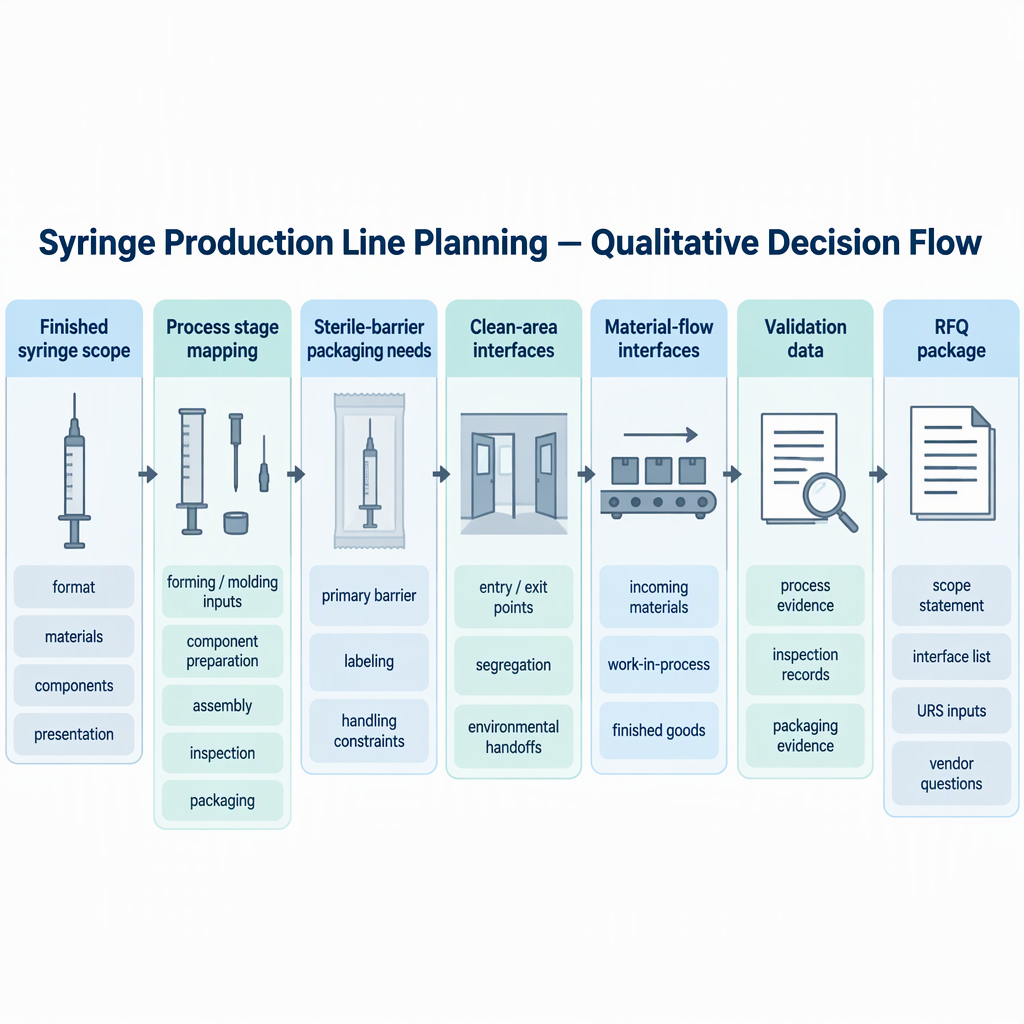
A useful syringe production line RFQ combines product scope, process stages, packaging requirements, clean-area assumptions and validation expectations; the equipment discussion can include molding, printing, automated assembly, blister packaging and sterilization handoff, while the product scope should stay within the intended syringe category and the packaging scope should identify the sterile-barrier system requirements.
- Finished syringe definition: manual-use syringe type, sizes, needle or no-needle configuration, exclusions and target markets.
- Process scope: molds, injection molding, printing, assembly, blister packaging, sterilization handoff and workshop zoning responsibilities.
- Packaging scope: sterile-barrier material, blister format, sealing concept, labeling needs and terminal-sterilization route.
- Facility inputs: available room sizes, clean and non-clean flows, utilities, HVAC interfaces and material-storage limits.
- Qualification inputs: documentation requirements, acceptance tests, sample quantities, installation support and training expectations.
- Commercial comparison inputs: quote format, inclusions, exclusions, spare parts, optional modules and assumptions that must be priced separately.
| If this is unclear | Ask the supplier to clarify | Do not assume |
|---|---|---|
| Line capacity | What product size, cavity count and configuration the quotation uses. | A universal output rate without product conditions. |
| Packaging responsibility | Whether blister tooling, packaging materials and seal testing are included. | That a packaging machine quote covers the full sterile-barrier validation package. |
| Cleanroom scope | Whether the supplier provides layout support only or facility engineering scope. | That a production line quote defines the required cleanroom class. |
| Compliance documents | Which machine documents, FAT/SAT templates and certificates are available. | That any supplier page proves finished-device approval. |
Conclusion: plan the line as a controlled system, not a machine list
The strongest syringe production line plan starts with the finished device, then connects each process interface to packaging, facility and validation decisions before quotation.
- Confirm that the project fits the intended manual sterile syringe scope before selecting equipment.
- Plan molding, printing, assembly, blister packaging and sterilization handoff as one connected flow.
- Convert sterile-barrier packaging expectations into RFQ inputs before comparing machines.
- Keep quality-system responsibility with the finished-device manufacturer and use supplier information as project input, not as approval evidence.
FAQs about syringe production line planning
Use these questions to close scope gaps before equipment comparison, quotation and project validation planning.
Can this plan cover prefilled syringes, insulin syringes or pump syringes?
Not as a direct plan. The FDA recognition record for ISO 7886-1:2017 excludes insulin syringes, glass syringes, power-driven pump syringes, prefilled syringes and syringes stored after filling, so those projects need separate product and equipment requirements.
Does sterile-barrier packaging planning replace sterilization validation?
No. ISO 11607-1:2019, as described in the FDA record, covers materials, sterile-barrier systems and packaging systems intended to maintain sterility of terminally sterilized devices; it does not by itself complete product-specific sterilization or process validation.
Does citing FDA QMSR mean the supplier or line is FDA approved?
No. The FDA QMSR page provides quality-system regulatory context for finished device manufacturers; it does not approve a supplier, certify a production line or validate a specific installation.
Which stages should be discussed together in the first supplier meeting?
Discuss molds, injection molding, barrel printing, automated assembly, blister packaging, sterilization handoff, workshop zoning, installation and support scope together, because each interface affects layout and qualification planning.
Should the buyer request a fixed cleanroom class in the first RFQ?
Request the clean-area assumptions, flows and facility interfaces, but have the required classification set by your quality, regulatory and facility teams for the specific product and market rather than treating a generic class as universal.
Can a buyer compare price or capacity before product details are fixed?
Only at a rough screening level. A meaningful comparison needs syringe size, component design, mold and cavity assumptions, packaging format, automation scope, cleanroom boundary and acceptance-test expectations.
What does the verified supplier page support in this planning guide?
It supports the described full-line categories—molds, injection molding, printing, assembly, blister packaging, ETO sterilization, workshop zoning, installation and technical support—but it should not be read as proof of capacity, certification, finished-device approval or project-specific validation.