
Views: 0 Author: Site Editor Publish Time: 2026-08-20 Origin: Site

In high-volume medical device manufacturing, selecting equipment is rarely about finding the fastest machine available. Instead, it is about securing the highest verifiable yield day after day. You need reliable systems capable of meeting relentless global demands. Scaling up production introduces a major challenge for plant managers. You must increase throughput without compromising the strict zero-defect mandates of ISO and WHO standards. Even a fraction of a percent in defect rates can lead to catastrophic product recalls or severe patient harm.
This article provides an evidence-based evaluation framework to guide your next equipment investment. We will explore how to assess true capacity, mechanical reliability, and in-line detection capabilities effectively. You will learn to look beyond raw speed to find machinery built for uncompromising quality before initiating procurement.
Nameplate capacity (Parts Per Minute) often misrepresents actual throughput; evaluate machines based on guaranteed Overall Equipment Effectiveness (OEE) and rejection rates.
Reliable production requires 100% in-line inspection, prioritizing multi-camera machine vision and non-destructive mechanical pull tests.
Modular designs reduce downtime during changeovers, particularly when transitioning between standard hypodermic and safety needle formats.
Vendor shortlisting must weigh Factory Acceptance Testing (FAT) rigor and localized integration support as heavily as raw machine specs.
High-speed assembly is consistently bottlenecked by the slowest verification step. When moving from manual or semi-automated processes to fully automated lines, you require highly predictable cycle times. True efficiency in syringe needle production emerges only when mechanical assembly speeds align seamlessly with real-time quality control checks.
You must establish clear business success criteria to justify the required capital expenditure (CapEx). Plant managers usually calculate the specific threshold where an automated system pays for itself. You reach this threshold through a drastic reduction in material scrap rates and a significant drop in labor overhead. An automated system eliminates the inconsistencies inherent in human assembly.
However, you must also account for several hidden costs before finalizing any equipment layout. These factors heavily influence your ultimate return on investment:
Floor space footprint: Large, sprawling machines consume valuable cleanroom real estate.
Cleanroom utility requirements: Evaluate the exact consumption of compressed air, industrial power, and localized vacuum systems.
Operator training complexity: Highly complex HMIs require extensive staff training, increasing your startup timeline.
Manufacturers often advertise a theoretical maximum speed, known as nameplate Parts Per Minute (PPM). You must differentiate this theoretical number from sustained operational capacity. A machine running at 1,000 PPM but experiencing frequent micro-stops will yield fewer viable products than a stable machine running at 600 PPM.
Format variations severely impact your overall cycle times. Handling micro-components during hypodermic needle assembly requires extreme precision. The delicate nature of thin-walled stainless steel slows down the feeding mechanisms. In contrast, larger veterinary needles or blunt-fill formats tolerate more aggressive handling, allowing for higher continuous speeds.
| Evaluation Metric | Theoretical (Nameplate) | Actual (Operational) | Impact on Output |
|---|---|---|---|
| Speed | Maximum mechanical limit | Sustained speed without defects | Determines true shift production |
| Downtime | Assumes 0% stoppage | Accounts for jams and reloads | Reduces net yield significantly |
| Changeovers | Not factored | Time spent swapping tooling | Affects multi-product flexibility |
Vibratory bowl feeders act as the primary pace-setters. Unfortunately, they also represent a frequent source of downtime. Components can jam or feed in the wrong orientation. Advanced systems mitigate this using specialized bowl coatings and vision-guided rejection systems that purge misaligned parts before they jam the main track.
Modern production facilities rarely run a single product size year-round. Tool-less changeovers provide a massive operational advantage over complex mechanical recalibrations. Systems utilizing quick-release modular fixtures allow operators to switch formats in minutes rather than hours, preserving your daily yield.
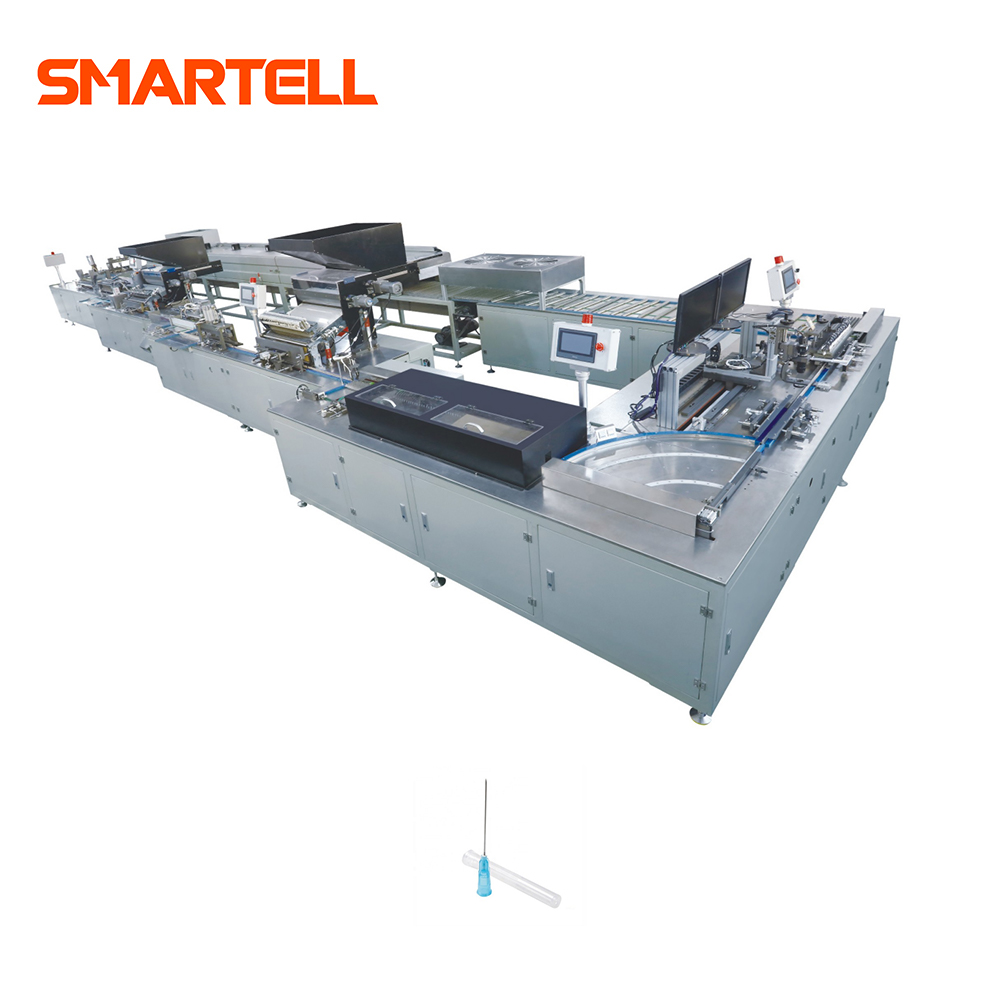
Every automated line relies on sequentially linked stations. The mechanical tolerance at each step dictates the success of the final medical device. We can break this down into four critical phases.
Needle Hub Assembly: You face strict precision requirements when aligning the plastic hub and the stainless steel cannula. If your needle hub assembly station fails to center the cannula perfectly, the subsequent adhesive application will be asymmetrical.
Dispensing & Curing: Evaluating epoxy or UV glue dispensing consistency is critical. Over-application causes internal blockages within the cannula. Conversely, under-application leads to mechanical failure during patient use. Curing stations must deliver uniform UV exposure to guarantee the bond strength.
Cannula Integration: The integration of a high-quality needle cannula machine determines how well your system handles delicate stainless steel. Continuous motion feeding generally offers smoother transitions than indexed motion. This prevents sudden jerky movements, protecting sharp tips from microscopic bending or burring.
Siliconization Precision: To ensure a painless injection, manufacturers apply medical-grade silicone to the needle tip. You must control the atomization and spray volume flawlessly. Excess silicone will contaminate the adhesive joints, weakening the bond and causing batch failures.
Statistical sampling is entirely insufficient for Class II and Class III medical devices. The industry mandate demands zero defects. A single flawed needle reaching the market triggers costly regulatory investigations. Therefore, your automated line must incorporate 100% in-line verification systems.
| Inspection Area | Defect Targeted | Detection Technology | Regulatory Standard |
|---|---|---|---|
| Cannula | Bent tips, burrs, reversed | Multi-axis Machine Vision | ISO 7864 |
| Adhesive | Micro-bubbles, missing glue | UV-Luminescence Cameras | Internal QA / ISO 13485 |
| Patency | Internal blockages | Air Pressure Decay | ISO 7864 |
| Bond Strength | Weak hub-to-cannula bond | Automated Pull-Force Testing | ISO 7864 |
High-resolution machine vision systems inspect every single needle. They identify reverse needles, bent tips, microscopic burrs, and entirely missing cannulas. Cameras capture images from multiple angles in milliseconds, signaling the PLC to reject non-conforming items instantly.
Standard cameras struggle to see clear epoxy on clear plastic. Systems overcome this by using UV-luminescence cameras. These specialized sensors verify 360-degree adhesive coverage. They easily spot dangerous micro-bubbles that compromise the structural integrity of the seal.
Mechanical verification ensures the needle functions as intended. Air pressure decay tests shoot a microscopic burst of air through the cannula. If the sensor detects resistance, it indicates an internal blockage caused by excess glue or debris. The machine immediately purges the blocked needle.
You must align your production with ISO 7864 standards for bond strength. High-end systems perform automated, non-destructive tension checks on a specialized testing wheel. A mechanical arm applies a precise pull force to the cannula. If the bond holds, the needle passes; if it slips, it fails.
Global healthcare markets increasingly mandate the use of safety-engineered devices to protect workers from needle-stick injuries. This shift dramatically affects equipment selection. Accommodating the mechanical steps required for safety needle assembly introduces unique design complexities. The machine must snap hinged sheaths, guide sliding shields, and verify locking mechanisms without slowing down the primary indexing dial.
You must also maintain absolute sterility. The equipment itself must meet cGMP and ISO Class 7/8 cleanroom standards. Stainless steel surfaces must be sloped to prevent particle accumulation. Pneumatic exhausts must be routed outside the cleanroom environment, and all moving parts must utilize food-grade, non-shedding lubrication.
Data integrity is equally non-negotiable. Modern systems must comply with 21 CFR Part 11 requirements. You need to evaluate the machine’s Human-Machine Interface (HMI) and Programmable Logic Controller (PLC). They must feature secure audit trails, strict user access controls, and automated batch reporting. This ensures every parameter change is permanently logged and traceable.
Even the most advanced machine will fail if it operates in a silo. You must assess how the single use needle assembly machine will handshake with your wider facility. It needs to accept materials cleanly from upstream molding machines and transfer finished goods seamlessly into downstream blistering or packaging lines. Poor integration causes bottlenecks that destroy your overall yield.
When structuring your Factory Acceptance Testing (FAT) and Site Acceptance Testing (SAT), enforce rigorous protocols. Always insist on using your actual production materials. Vendors often tune machines using optimized, perfectly molded sample batches. Real-world components carry slight variations. Testing with actual materials exposes feeding issues before the machine leaves the vendor's facility.
Use a strict vendor evaluation matrix when shortlisting potential partners. Do not rely on price alone. Consider these critical criteria:
Localized support: Ensure the availability of localized spare parts and factory-trained service technicians in your region.
OEE guarantees: Demand absolute transparency regarding Overall Equipment Effectiveness guarantees embedded in the contract.
Historical deployment: Request historical deployment data and reference contacts for machines operating in similar regulatory environments.
Final procurement decisions should always balance high-speed throughput with uncompromising automated inspection. Raw speed offers no financial benefit if it generates a high volume of defective, unusable medical devices. By prioritizing in-line quality verification, you secure a predictable and compliant manufacturing process.
Your immediate next step is to build a standardized User Requirement Specification (URS) document. Base this document directly on the detection checklist provided in this article. Using a strict URS forces competing vendors to quote apples-to-apples performance metrics, allowing you to select a partner equipped to deliver true operational excellence.
A: Output typically ranges from 150 to over 1,200 PPM. The exact speed depends heavily on whether the system uses indexed or continuous motion. The complexity of the needle design also plays a major role in determining sustained throughput.
A: Yes, you can achieve this through modular tooling. However, safety mechanisms usually require additional automated stations for shield attachment and locking verification. Adding these extra steps may reduce your overall PPM compared to standard formats.
A: High-end equipment utilizes specialized vibratory bowl coatings to cushion components. They pair this with gentle pick-and-place robotics and continuous visual tracking. These integrated systems identify and reject misaligned parts long before the insertion phase, protecting delicate cannula tips.
A: The most common causes include incomplete glue curing, bent cannulas from aggressive feeding mechanisms, and siliconization inconsistencies. You must ensure your machine features robust, 100% in-line detection systems to catch these specific defects immediately.